
Blog
“The Geisha” – who is a geisha really?
Jul
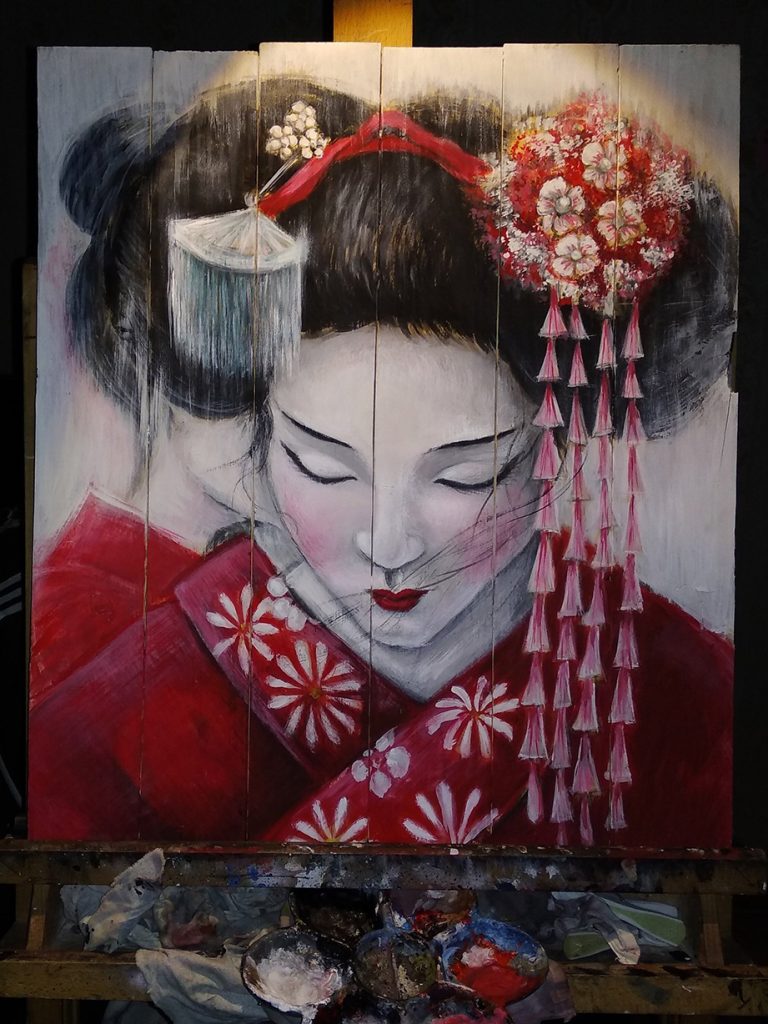
In our designs, we often choose to depict geishas with their mysterious charm and their stunning kimonos.
I recently came across the book *Memoirs of a Geisha* in a second-hand shop and decided to buy it. I must say I’ve found it really gripping and I’ve almost finished reading it; next I’ll get round to watching the film, which, for obvious reasons, I’ve put on hold.
Very few people really know what a geisha is; here’s a brief summary.
THE GEISHA: WHO IS A REAL GEISHA (Geiko in Kyoto and Geigi in the Kanto region and elsewhere)? AND WHAT ABOUT THE MAIKO?
Geisha are refined entertainers, skilled in the traditional Japanese arts (dance, singing, musical instruments, games, wit, etc.), whilst maiko are their “apprentices” – a figure that was very common in the 18th and 19th centuries but is now gradually disappearing. Geisha are women who are particularly skilled in music, singing and dance. An apprentice geisha is called maiko. The maiko originally from Gion district (the “geisha district” of Kyoto) is also often referred to as a geiko. The 2005 film Memoirs of a Geisha, which in turn is based on the novel of the same name by Arthur Golden, has helped to popularise this character in the West, often in a stereotypical way.
The image people usually have of a geisha is that of a woman with very pale skin, with black hair styled into elaborate hairstyles and wearing flamboyant kimono. In fact, this style of dress is more typical of a maiko than of a geisha.
The story
The first true geishas appeared around 1600, when courtesans dedicated to entertaining the nobility began to attend high-society parties. Men were also often called upon to fulfil this role. When prostitution was legalised in Japan in 1617, brothels and houses of pleasure began to spread throughout the major cities, and the distinction between geisha and prostitutes began to blur. In the nineteenth century, specific laws were enacted prohibiting geishas from engaging in prostitution, and in the major cities – particularly Tokyo and Kyoto – certain districts were designated for teahouses and geisha houses.
Tradition has it that, to become a geisha, training began in childhood. Usually, the young girls who decided to become geishas were the daughters of geishas themselves. As soon as they arrived at the okiya, the “geisha house”, the girls learnt domestic tasks (which were often very demanding). They then went on to learn entertainment skills, such as playing the shamisen and the shakuhachi (a bamboo flute), perform traditional dances, sing and serve tea and sake correctly.
Once they had passed a dance exam, they progressed to the second level of apprenticeship: assisted by the older apprentices, they learnt the complex process and technique of putting on a kimono and how to entertain customers. They would attend banquets where their older sisters served, without taking an active part themselves, but wearing striking make-up and flamboyant attire. The third stage of apprenticeship was, finally, that of the maiko. At this stage, the aspiring geisha would accompany her onee-san (her “elder sister”) to all her engagements, learning in particular the art of conversation. At this point, the maiko could choose a stage name to practise her craft as a geisha.
After a maximum of five years, the maiko would finally become a geisha, a title she would retain until her retirement. The geisha could then begin to repay the debt she had incurred with the okiya, which had covered all the apprentice’s expenses during her training. To this day, traditional Japanese geisha follow roughly the same training process as set out in the kenban, a sort of professional register, which requires them to follow specific rules regarding dress and lifestyle.

 Italian
  English